A Tuesday in week five: what a day of limb lengthening actually looks like
Day 31, both femurs, 2.6 cm in, a Yerevan apartment with an elevator. Four turns, a nurse, a physiotherapist with a goniometer, a Denver standup at 7 p.m., a café on crutches, and a cramp at 2:10 a.m. A composite day, told straight.
Medically reviewed by Prof. Arshak Mirzoyan, MD, DMedSc. Last reviewed 16 October 2026.

In short: A representative day in week five of LON femur lengthening in a Yerevan apartment: four quarter-millimetre turns, a nurse visit for sixteen pin sites, an hour and more of physiotherapy, remote work across a ten-hour time difference, a short outing on crutches, broken sleep and a night cramp. Composite, not a template; bad days exist too.
Tom is not one person. He is a dozen patients from the last few years, a Korean account manager, a British electrician, two American software engineers, a Russian dentist and others, assembled under one name so that this reads as a day rather than a chart. Everything below happened to someone in our care; not all of it to the same person, and none of it is promised to you.
He is 31, both femurs, LON, planning 7 cm (about 2.75 inches). It is a Tuesday in late October, day 31 since surgery and day 26 of turning, which puts him at 2.6 cm (about an inch) of new bone in each thigh. He lives, for now, in a two-room apartment off a tree-lined street in central Yerevan, third floor, elevator, step-free shower. His mother flew home nine days ago. The frame on each thigh tents the duvet like a small camp.
06:40, the first quarter-millimetre
He wakes before the alarm because his left hamstring has cramped. He has learned not to fight it: knee straight, foot pulled back, breathe, forty seconds. It passes. Through the window there is the pale gray light that means Ararat will be visible once the haze lifts, which it was not yesterday.
At seven he does the first turn. On each frame there are the distraction rods, and each one gets its quarter turn, in the order the nurse drilled into him in hospital. It takes about ninety seconds for both legs and he feels nothing in particular, which no longer surprises him. He writes the time in the paper log on the bedside table, photographs the page and sends it to his coordinator, who replies with a thumbs-up within ten minutes most days. The log is not bureaucracy. If a nerve starts complaining on Thursday, the surgeon will want to see whether anything about the turns changed on Tuesday.
The shower takes twenty-five minutes and involves more sitting than showering. The stool is in the corner, the hand-held head is on its hook at seated height, and the frames are kept dry the way he was shown in hospital. He has done this thirty times. It still feels like a procedure rather than a wash.
Breakfast is three eggs, a bowl of matsun, the thick local yogurt he had never heard of before and now buys by the litre, a torn sheet of lavash and a handful of walnuts. The protein is deliberate; the physiotherapist asked in week two how much he was eating and did not like the answer. A vitamin D tablet, because his pre-operative blood test was low. Coffee, one, because two make the night cramps worse and he has tested this more than once.
09:30, the nurse and sixteen small wounds
The nurse arrives at half past nine, as she does most mornings, and spends twenty minutes on the pin sites. Eight on each leg, where the pins pass from the frame through the skin to the bone. She cleans each one, looks, and moves on. Fourteen are what she calls quiet. Two on the right thigh, the outer pair, are pink and a little tender. Not infected, she says; watch. She photographs them, notes it, and tells him to tell her if they are redder tomorrow or if he gets a temperature. He will not sleep worse for this, because it has happened twice before and both times it settled. Pin-site irritation is the most common complication of the whole process, and this is what managing it looks like: a competent person looking at your legs every day and noticing things early.
She also asks about his bowels, his sleep and whether he has been doing the evening stretches. He lies slightly about the last one and she knows.
11:00, the hour that decides the result
The physiotherapist arrives at eleven. Tom’s feelings about her are the mixed feelings every patient has about the person who bends their knees past the point where they would stop.
Warm-up first: ankle pumps, quad sets, a few minutes of supported standing. Then the part he dreads, prone on the bed, face in the pillow, while she slowly folds each knee toward the buttock and holds it. The goniometer reads 95 degrees on the left today. On Friday it read 100. She does not say anything, but she adds ten minutes. The quadriceps on a femur that is 26 millimetres longer than it was a month ago does not want to be folded, and losing knee flexion during distraction is the thing she is paid to prevent. He counts the holds in Armenian because she does, mek, yerku, yerek, up to forty, and then again, and it is the only time in the day he swears out loud.
Hip flexor stretches at the edge of the bed. Hamstrings with a strap. Then gait: up and down the corridor with the walker, weight set at what the surgeon allows, then two careful lengths on crutches, which is new this week. She watches his hips. When they swing she makes him do it again. The session runs an hour and a quarter and he is damp with sweat at the end of it, from an activity that involved lying on a bed. She leaves him three rounds of homework for the rest of the day, each about twenty minutes, and the number she wants to see on the goniometer by Friday. The reasons this matters more than anything the surgeon does with a scalpel are in our post on the physiotherapy that decides your result; today, the reason is simply that she will be back on Wednesday.
12:30 to 17:00, the second and third turns, and a day job
Lunch arrives from a delivery app: lentil soup, grilled chicken, more bread than he ordered, because it is Armenia. At one o’clock, the second turn. Log, photograph, send.
Then work. Tom writes back-end code for a company in Denver, which is ten hours behind Yerevan. The arrangement, agreed with his manager before he flew, is that he works a reduced day, mostly in the Yerevan afternoon when nobody in Denver is awake to interrupt him, and shows up for the team call at seven in the evening. This is, he says, the most productive he has been in years, and the most tired. Laptop on a tray, legs up on the sofa, a timer that goes off every forty-five minutes so that he stands, does twenty ankle pumps and one of the stretches, and sits back down.
At half past two he spends twenty minutes on the subreddit, which he has promised himself he will stop doing, reads a post from someone at week two panicking about a tingling foot, types a reply about telling the surgeon the same day, and deletes it, because he is not a doctor and the thread already contains six people who are certain.
At half past three he goes out, because the rule is that he leaves the building every day. Crutches, elevator, the heavy street door that he has learned to open with a hip. The café is about 200 metres away and he has timed the route: four curbs, one of them awkward, eleven minutes there, thirteen back. The barista starts his order when she sees him coming. An older woman at the next table asks in Russian what happened to his legs and he says football, because it is simpler, and she tells him about her nephew’s knee. He stays forty minutes, mostly looking at the street, and it is the part of the day he would miss most if it were taken away.
Five o’clock, the third turn, then the afternoon dip, which arrives on schedule. He sleeps for half an hour on top of the covers with his shoes still on. The physiotherapist told him to nap without guilt, and he has taken the instruction seriously.
18:30 to midnight, the call, the mood, the last turn
Second round of homework stretches, done properly this time because the goniometer number has been bothering him. Then the Denver call at seven, camera framed from the chest up. Two people on his team know where he is and why. The rest think he is working remotely from a relative’s place for a few months, which is true in every detail that matters.
Dinner is whatever the lunch place sent too much of. At eight his girlfriend calls from the time zone he left, and this is the part of the day where week five shows itself. He is not in pain. He says this several times, because she keeps asking. He is sore, and stiff, and bored in a way that has texture: every day is the same day, the number on the X-ray goes up in increments too small to feel, and the end is five weeks away, which is both not long and exactly as long as he has already done. “I’m fine,” he says. “I just want it to be December.” This is the wall that we describe to every patient in the first consultation, and that most of them hit somewhere between week five and week eight, and knowing its name does not make it pleasant, only survivable. What the whole arc of discomfort looks like, from the hospital days to the months at home, is in our post on how painful limb lengthening actually is.
At half past nine his coordinator messages: the nurse’s note about the two pink pin sites has gone to the surgeon, who wants to look at them at Thursday’s scheduled X-ray rather than sooner; the car will come at ten; bring the log. Tom asks whether the 95 degrees is a problem. The coordinator says the physiotherapist has flagged it and the surgeon will decide on Thursday whether to slow the rate for a few days, which is a normal adjustment and not a setback. Tom does not entirely believe the second half of the sentence, and says so, and the coordinator says that is fair.
Ten o’clock, the fourth turn. Log, photograph, send. Medication as scheduled. Then the arrangement of the bed, which has rules: no pillow under the knees, however much the knees would like one, because a knee that sleeps bent for twelve weeks learns to stay bent. A pillow under the heels instead. Phone charging within reach, because at some point in the night a muscle will seize and he will want the light.
It happens at ten past two, the right calf this time. Forty seconds. He is asleep again by half past.
The same Tuesday in week one, week eight and week twelve
| Week 1 | Week 5 (this Tuesday) | Week 8 | Week 12 | |
|---|---|---|---|---|
| Where | Hospital, then first days in the apartment | Apartment | Apartment | Hospital for frame removal, then apartment |
| New bone | 0 to 2 mm | About 2.6 cm | About 4.7 cm | 7 cm; target reached |
| Getting around | Walker, bed to door; wheelchair for anything else | Walker indoors, crutches new, café round trip | Crutches everywhere; walker in the corner | Crutches, frames off, legs suddenly light |
| What hurts | Deep surgical pain, medicated on a schedule | Tightness, pin sites, night cramps | Knee range is the daily fight; pins routine | Pin sites healing; a new ache in the regenerate |
| Sleep | Poor, interrupted by nurses and pain | Six broken hours and a nap | Better; cramps rarer | First full nights in three months |
| Physio | Standing, breathing, first steps | Five days a week, 75 minutes plus homework | Hardest sessions of the stay | Continues on the nail alone; focus shifts to strength |
| Work | None | Reduced remote day | Near-normal remote hours | Packing, paperwork, fit-to-fly |
| Mood | Relief it is done; shock at how it feels | The wall | Countdown has started | Impatient, grateful, a little afraid of the flight |
The week-eight and week-twelve columns are the same composite patient, projected forward along the typical path. The full stay, including how the apartment is priced (from about $900 to $1,400 per month as a guide) and what we look for in one, is on our stay in Yerevan page; the dated version of the whole process is on the timeline page.
What this Tuesday leaves out
It leaves out the bad days, and there are bad days. The Tuesday when one of those pink pin sites is red and hot and the nurse starts antibiotics the same morning. The Tuesday when the surgeon looks at the X-ray and slows the rate to half for a week because the regenerate looks thin, and the finish date moves. The Tuesday when the tingling on the top of the foot is real and the frame is adjusted. The Tuesday that is simply bleak for no clinical reason at all. Every one of these has happened to someone we have coordinated, and the written list of what can go wrong, how often and how it is handled is on our risks and complications page, which we would rather you read in full than skim.
It also leaves out the companion. Tom’s mother was there for the first two weeks, and those were different days: easier, and in some ways harder, because she worried visibly. Patients who are alone for the middle stretch, as most are, build the routine above because the routine is what carries them. Patients with company for the whole stay build a different one. Neither is wrong.
And it leaves out the end. In the week-twelve column the frames are off and the flight home is booked, but the bone inside the thighs is still soft and the nail is still carrying it, and months of consolidation, crutches and strength work are ahead before Tom walks into his Denver office without anyone noticing anything except, eventually, that he seems a little taller. A Tuesday in week five is the middle of the story, which is exactly why we chose it.
If you want to picture your own Tuesday
The point of writing a day down is that most of what makes lengthening hard is not in the surgical description. It is the repetition: the turns, the pin care, the goniometer, the curbs, the same café, the same call. If reading this made you tired, that is useful information about you. If it made you think “I could do that”, that is useful too, and it is a better basis for a decision than a before-and-after photo.
Your own version will differ in the details that matter: which bone, how many centimetres, how your knee behaves, whether you have company, what your work allows. The person who can turn those variables into a plan is the surgeon, and the input he needs is X-rays. Send them with your questions and ask him what your weeks would look like; we will tell you plainly if the answer is that they should not happen at all.
This article is educational and is not a substitute for a consultation with a qualified surgeon. Individual results vary.
Questions people ask
What does a typical day of limb lengthening look like?
Four quarter-millimetre turns spaced through the day, a nurse visit for pin-site care, a physiotherapy session of about an hour and more on weekdays plus home stretching rounds, meals heavy on protein, some hours of remote work if you have a desk job, one short outing on a walker or crutches, an afternoon rest, and a night that may be interrupted by a cramp.
Can you work remotely during limb lengthening?
Most patients with laptop jobs do, from the second or third week, at reduced hours. Yerevan is UTC+4, so a US team’s working day falls in the Yerevan evening and an East Asian team’s in the morning, which many patients find suits a routine built around morning physio. Fatigue, not ability, sets the limit.
Do you have to be alone during limb lengthening abroad?
No, and many patients bring a companion for the first two weeks, when the help matters most. Most are alone for the middle of the stay and build a daily routine around turns, physio, nurse visits, work and one outing. A nurse and a physiotherapist visit on weekdays and a coordinator is reachable throughout.
How many times a day do you turn the frame?
Four, each a quarter of a millimetre, for about 1 mm a day in total. Patients typically space them at roughly morning, midday, late afternoon and bedtime, record each turn in a log and share it with the coordinator. The individual turn is barely felt; the cumulative tightness is what the daily physiotherapy addresses.
Is every day of limb lengthening the same?
The structure is deliberately the same, which is part of what patients find hard around weeks five to eight. The content varies: X-ray days every two weeks, days when a pin site needs antibiotics, days when the surgeon slows the rate, and days that are simply low. A representative day is a middle, not a promise.
Keep reading

Running, sport and the gym after limb lengthening: what comes back, what may not
Most patients run again after limb lengthening, usually 9 to 12 months on. Here is the order sport returns, the sprint and jump deficits athletes report, and the three ways people lower their own ceiling.
Read the article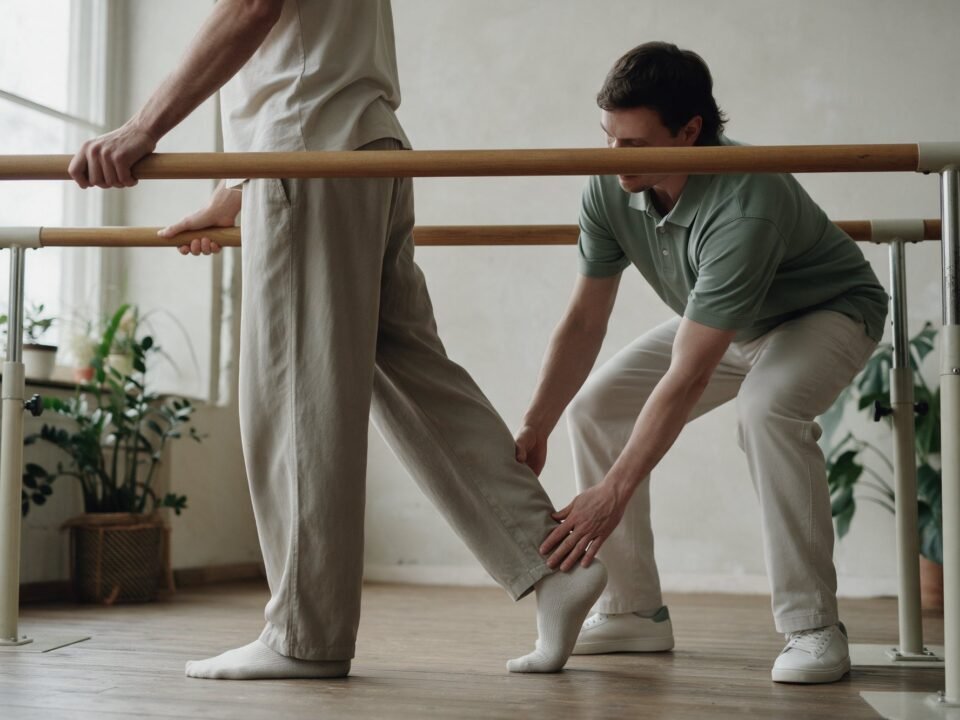
The physiotherapy that decides your result: stretching, strength and the hours nobody shows on Instagram
Bone grows on schedule; muscle and tendon do not. The sixty-odd sessions and the home rounds nobody films decide whether your knee bends and your heel reaches the floor. What the program contains, and what skipping it costs.
Read the article
Ilizarov Frame Removal: When It Happens, What It Feels Like and the Weeks After
How surgeons decide the new bone is ready, what Ilizarov frame removal involves, the refracture risk and what the first weeks without the frame look like.
Read the articleBegin with a conversation.
No commitment, no pressure. Send your questions and, if you have them, your X-rays. You will hear back from a person within one working day.
Book a private consultation