Turkey or Armenia for limb lengthening? An honest comparison
Turkey wins most of the comparisons you can make in ten minutes, and we say so. The ones that take longer, about who operates, what is written down and what three months feel like, are where Armenia earns a look.
Medically reviewed by Prof. Arshak Mirzoyan, MD, DMedSc. Last reviewed 29 October 2026.

In short: Turkey has more agencies, more flights, more patient videos and published Precice prices; Armenia has one senior surgeon, a smaller program and lower totals. We compare prices, the three-month stay in Istanbul versus Yerevan, flights, safety and follow-up for UK and US patients, and list the questions to ask both.
Turkey will win most of the comparisons you can make in ten minutes. It has more agencies, more surgeons doing lengthening, more flights into Istanbul from more cities, and more patient videos on YouTube than every other country combined. If you have spent an evening on the subreddit, you have watched a Turkish recovery vlog, probably several. You have not watched an Armenian one, because there are very few.
We would rather say that at the top than hope you do not notice. We run a lengthening program in Yerevan, we are the competitor in this piece, and the comparison is only useful if we are fair to the other side. So here is what Turkey does better, what we think we do better, where the two are closer than either side’s marketing admits, and the questions we would ask both of us if we were a patient in Birmingham or Phoenix with a deposit in hand.
What Turkey does better, plainly
Scale, first. Turkey’s lengthening sector is agency-led, and the agencies are good at what agencies do: they answer messages quickly, in good English, with a price on the first reply. The leading agency advertises LON at about $26,400 all-inclusive and a recovery apartment at about $6,750 for three months, and it publishes those numbers on a page anyone can read. That transparency is worth something and not every provider manages it.
Device choice, second. If you want a fully internal magnetic nail (we compare what each device is like to live with elsewhere), Turkish providers list Precice 2 at $56,000–58,000 as a standard menu item. With us, the fully internal nail is available on request and its availability is confirmed at consultation, which is a weaker promise than a price on a page, and we will not pretend otherwise.
Community, third. Because so many patients have been through Istanbul, you can find a recent video diary for almost any combination of method, bone and starting height. For a decision that most people make alone and tell nobody about, watching someone two weeks ahead of you is reassuring in a way no article is. Turkey also has the logistics of a country built for medical tourism: hospitals used to foreign paperwork, drivers, SIM cards, English menus.
Flights, fourth. Istanbul is one of the largest airline hubs on earth. From London it is a short direct flight; from the US there are direct flights from several cities. Yerevan has direct flights from London, Paris, Frankfurt, Vienna, Warsaw, Doha, Dubai, Istanbul and Moscow, and from the US it is one connection, usually through Doha, Dubai or Istanbul itself. For a UK patient the difference is an hour or so. For an American it is a longer day and a connection, and after surgery that connection matters more than it did on the way out.
Agency or surgeon: the question underneath the country question
When people compare Turkey and Armenia they are usually, without quite realising it, comparing two models of care. The Turkish model is the agency: a marketing and patient-services company that works with one or several surgeons, books the hospital, rents the apartment and keeps you company on WhatsApp. The surgeon may be excellent. The point is that the agency is the brand, and the surgeon’s name is sometimes on page three.
We are also a facilitator, not a clinic, and we say so on every page. The difference is that our program is built around one named surgeon, and the surgeon is the brand. Prof. Arshak Mirzoyan has operated since 1980, spent 1980 to 1989 at Ilizarov’s own institute in Kurgan, wrote his doctoral thesis on the method, founded the Yerevan Center of Limb Lengthening and Reconstruction in 1998 and still leads it. You can read that history on a hospital site that is not ours. He operates at a JCI-accredited partner hospital in Yerevan whose name and certificate are shared at consultation, and he reviews every X-ray himself, every two weeks, for every patient.
Neither model is automatically safer. A Turkish agency with a senior surgeon who does hundreds of cases a year is a strong option, and some of them have exactly that. The practical difference is where the burden of proof sits. In the agency model you have to work to find out who operates; in the surgeon model you start with the name and work outward to the hospital and the policies. Whichever you choose, the vetting is the same, and we wrote it out in twelve questions for any surgeon or agency. The first of them, “who exactly operates on me”, is the one Turkish agencies most often answer vaguely, and it is the one we would not let go of.
Prices side by side
Headline prices for a single-segment plan, usually both femurs, with what each provider says is included. The ranges for Turkey are from the providers’ own pages and 2026 cost surveys; ours is the current estimate, and the written quote follows the surgeon’s review of your X-rays.
| Item | Turkey | Armenia (Limblong) |
|---|---|---|
| LON, single segment, all-inclusive | About $26,400 at the leading agency; $26,400–38,000 across providers | $4,000 per centimetre (8 cm: $32,000) |
| Precice 2 (fully internal), single segment | $56,000–58,000 | On request; availability and price confirmed at consultation |
| Staged femur + tibia (12–16 cm) | Quoted individually | $4,000 per centimetre (12–16 cm: $48,000–64,000) |
| Recovery apartment | About $6,750 for 3 months at the leading agency | from about $900 to $1,400 per month, vetted for elevator and step-free shower |
| Hospital stay | Varies by provider | About 4 nights, private room |
| Physiotherapy during stay | Ask whether included and how many sessions | Five days a week for roughly 12 weeks, included |
| Nail removal, 1–2 years later | Quoted separately | Quoted separately |
Advertised prices from providers’ own pages and 2026 cost surveys, checked October 2026. A guide, not a quote.
The LON gap is real but not enormous, and it narrows or widens depending on what sits inside “all-inclusive”. Ours covers surgeon and hospital fees, implants, anesthesia, about four hospital nights, frame removal, roughly twelve weeks of physiotherapy and nurse visits for pin-site care, every X-ray during the stay, transfers, a walker and crutches, the coordinator, and a written complication policy. It excludes flights, accommodation, meals, insurance and the optional nail removal. The useful exercise is not to compare the two headline numbers but to put the Turkish agency’s inclusion list next to ours and count the differences. Physiotherapy sessions and X-rays are the two lines most often missing or capped, and over twelve weeks they add up.
If you are set on Precice, the comparison is simpler: Turkey has a published price and we do not. Ask us anyway, but go in knowing that.
Three months in Istanbul or three months in Yerevan
This is where the two countries differ most, and where a 24-year-old and a 40-year-old might reasonably choose differently.
Istanbul is one of the great cities of the world and a demanding one on crutches. It is enormous, it is built on hills, traffic is a daily fact and distances are long. If your apartment, your hospital and your physio are in the same district, as the agencies arrange, you may barely notice. If you want to see the city while you are there, and most people do in weeks nine to twelve, you will be doing it with a walker on cobbles and steps. For some patients the sheer amount happening around them is the point: three months is long, boredom is real, and Istanbul is never boring.
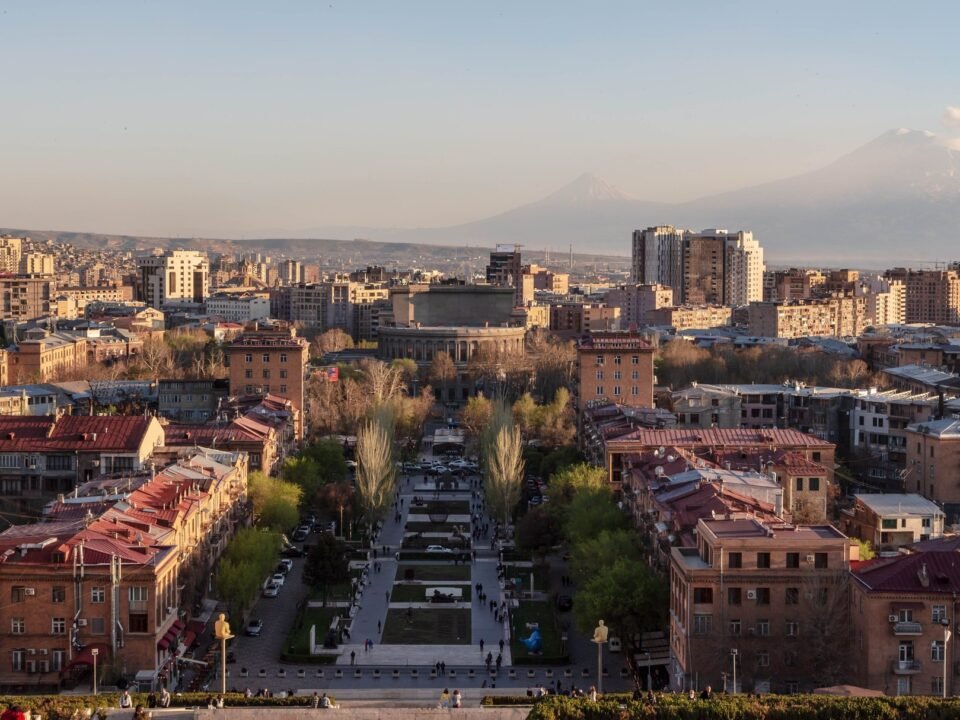
Yerevan is small, relatively flat in the center, and quiet by comparison. You can cross the central district on foot, or at least you will be able to by week ten. Cafés are everywhere and cheap, summers are hot and dry, winters are cold with occasional ice, and the time zone is UTC+4, which puts you three or four hours ahead of London depending on the season and eight or more ahead of the US, workable for a remote job in the afternoons and evenings. Fibre internet is standard in the apartments we use. Power is 230 V on type C and F sockets. Card payments are normal; a local card is arranged if yours gives trouble. The honest downside is that Yerevan does not offer much nightlife on crutches and the English-language scene is thin outside the center; the honest upside is that a season here is restful in a way a megacity cannot be, and you will spend less of it in taxis. The stay page goes into apartments, neighborhoods and what a week of groceries costs.
Language is roughly a draw. Turkish agencies run on English-speaking coordinators and interpreters at the hospital. We run on English-speaking coordinators; the surgeon speaks Russian and Armenian, and consultations with him are interpreted. If you speak Russian, Yerevan is noticeably easier than Istanbul, because the city does too.
Safety, for the people who will ask you about it
You will be asked, by a parent or a partner, whether it is safe. The index we can cite places Armenia 7th of 146 countries and Yerevan 15th of 329 cities on Numbeo’s 2024 safety ranking. We do not have Turkey’s position on the same index in front of us and would rather you looked it up yourself than take a number from a competitor. What we can say from watching patients is that in both cities the real risks for someone on crutches are kerbs, wet marble, drivers and the occasional missing paving stone, not crime. Yerevan’s center is compact enough that you will walk more and ride less, which is good for the regenerate and good for morale.
A different kind of safety is the hospital. Turkey has JCI-accredited hospitals, and the agency you talk to may use one; ask which, and ask to see the certificate rather than a logo. We use one, and we show the certificate at consultation. Accreditation tells you about the institution’s systems, infection control and record-keeping. It does not tell you about the surgeon, which is why the earlier section exists.
Follow-up and the bad-week question
Ask both of us the same thing: if a pin site turns into a deep infection in week seven, or a knee will not bend past seventy degrees in week ten, who treats it, where, and who pays.
Our answer is written down before you pay anything: complications are managed by the same surgeon in the same hospital, and the complication and revision policy, the full risk list and the price arrive together as documents, described on the patient protection page. After you fly home, X-rays taken locally go to the surgeon and there are video reviews at around three, six and twelve months.
Turkish agencies vary. Some have clear written policies; some have a reassuring sentence on a web page and nothing more. The scale that makes Turkey easy to reach also means a coordinator may be carrying many patients at once, and in a bad week that shows. Neither of these is a reason to rule Turkey out. They are reasons to ask for the document, read it, and notice how long it takes to arrive and whether it names the surgeon.
Questions to ask both of us
Send this list to the Turkish agency and to us, and compare the replies, including how long each took.
- Who operates on me, by name? How many lengthening cases has that surgeon done, over how many years, and may I see the CV somewhere other than your website?
- Which hospital, and can I see the accreditation certificate?
- What exactly is in the all-inclusive price? How many physiotherapy sessions, how many X-rays, how many hospital nights, and what happens if I need more of any of them?
- Is the complication and revision policy written down, and can I read it before I pay a deposit?
- Who reviews my X-rays during distraction, how often, and do I speak to the surgeon directly or only through the coordinator?
- What is the deposit, and what is refundable if the surgeon declines me after reviewing my X-rays?
- Can I speak to a former patient who had the same method, with no agency staff on the call?
- What does nail removal cost in one to two years, and will the same surgeon do it?
If you are choosing between the two
Choose Turkey if you want a fully internal nail at a published price, if you want the biggest community and the most video diaries behind you, if you want the shortest and simplest flight from the US, or if a megacity is what keeps you sane for three months. Those are good reasons, and plenty of patients have done well there.
Choose Armenia if you want a named surgeon with four decades of lengthening behind him looking at your X-rays himself, a program small enough that your coordinator knows your name and your knee angle, a lower all-inclusive LON total, a quiet and safe city, and written policies on price, risk and complications in your hands before any money moves. Those are specific preferences too, and they are the ones we built the program around.
Whichever way you lean, the next step is the same: your X-rays in front of a surgeon, not an agency. If you want ours to look, book a private consultation and we will tell you plainly whether you are a candidate, and if the answer is no, we will tell you that too.
This article is educational and is not a substitute for a consultation with a qualified surgeon. Individual results vary.
Questions people ask
Is limb lengthening cheaper in Turkey or Armenia?
For LON, Turkey’s leading agency advertises about $26,400 and the market runs $26,400–38,000, while our all-inclusive LON price in Yerevan is $4,000 per centimetre (about $32,000 for 8 cm); what it includes is on the cost page and the written quote follows the surgeon’s X-ray review. For Precice, Turkey publishes $56,000–58,000; with us it is on request. Compare inclusion lists, not headlines.
Is Turkey safe for limb lengthening surgery?
Many patients have had lengthening in Turkey with good results, and the country has JCI-accredited hospitals. Safety depends on the specific surgeon and hospital rather than the country, so ask who operates, how many cases they have done, which hospital, and whether the complication policy is in writing. The same questions apply to Armenia and to us.
Why is Turkey so popular for limb lengthening?
Scale. Turkey has the most agencies, the most surgeons offering lengthening, the most flights into Istanbul and by far the most patient videos online. Agencies reply fast in good English with published prices, including for fully internal nails. That makes Turkey easy to research and easy to reach, which is a genuine advantage over smaller programs like ours.
How do I get to Yerevan from the UK or USA?
From London there are direct flights to Yerevan, and from Paris, Frankfurt, Vienna, Warsaw, Doha, Dubai, Istanbul and Moscow. From the USA it is one connection, usually via Doha, Dubai or Istanbul. US and UK citizens enter Armenia visa-free for up to 180 days; re-check on mfa.am before booking. Wheelchair assistance is arranged for the flight home.
Should I choose an agency or a named surgeon for limb lengthening?
Either can be a good choice. Agencies, common in Turkey, handle logistics well but may work with several surgeons, so you must find out who operates. A surgeon-led program starts from the name and you check outward to the hospital and written policies. In both cases, verify the surgeon’s history, the hospital’s accreditation and the complication policy before paying.
How long is the stay in Istanbul or Yerevan for limb lengthening?
For a single-segment LON plan, typically 10–14 weeks in either city: surgery, about four hospital nights, roughly 80 days of distraction for 8 cm at about 1 mm a day, then frame removal. Consolidation continues at home for months. Istanbul is larger and hillier; Yerevan is compact and flat in the center, which matters on crutches.
Keep reading
From Japan to Armenia for limb lengthening: visa, flights, the zairyu-todoke, medicines and insurance
A practical guide for patients travelling from Japan to Yerevan: no visa for up to 180 days, flight routes, embassy registration, the permit for bringing painkillers home, and what Japanese insurance and tax rules will not cover.
Read the article
From the UK, Europe, Canada and Australia to Armenia for limb lengthening: visas, health cover and insurance
What patients from the UK, the EU, Canada, Australia and New Zealand need for treatment in Yerevan: who needs a visa (Canadians do), why the GHIC and EHIC do not apply, travel advice, flights, and the truth about complication insurance.
Read the articleLimb lengthening abroad from China, Japan, Korea and Russia
A Chinese reader cannot have it at home. A Japanese reader can, at ¥17.8 million. A Korean reader can, at a wide range of prices. A Russian reader lives where it was invented. One section per market: visas, flights, money, language.
Read the articleBegin with a conversation.
No commitment, no pressure. Send your questions and, if you have them, your X-rays. You will hear back from a person within one working day.
Book a private consultation