How many centimetres can you gain from limb lengthening? The honest ceiling
People arrive asking for 10 and leave with 7. Why one femur stops at 8 cm, how a staged plan reaches 12 to 16, where the risk curve bends, and what each number looks like in trousers.
Medically reviewed by Prof. Arshak Mirzoyan, MD, DMedSc. Last reviewed 29 October 2026.

In short: One femur lengthening gives most patients 6 to 8 cm; a tibia 5 to 7 cm. Lengthening both bones in separate stages reaches 12 to 16 cm over roughly two years. Complication rates climb past about 5 to 6 cm per bone, so anything beyond 8 cm should be staged, and proportions cap the sensible number before biology does.
The number people arrive with is 10. The number most of them leave with is 7.
That gap is not a failure. Ten is the number you pick in your bedroom, from a height chart; seven is the number a femur gives when it has been lengthened as far as the muscles around it will sensibly allow. Somewhere between the two is a conversation about proportions, about a second surgery, about how many months you can give this, and about where the risk starts to climb faster than the height. This article is that conversation, in advance.
We will use centimetres throughout, with inches in brackets where it helps, because the surgeon plans in millimetres and so should you.
The honest ceiling: per bone, and in total
Here are the numbers we work to, and we would rather you heard them now than after a deposit somewhere else.
A single femur lengthening with LON gives up to 8 cm (about 3.1 inches). Most of our femur patients finish between 6 and 8 cm. A single tibia lengthening gives up to 6 to 7 cm (about 2.4 to 2.75 inches), and most finish between 5 and 7. Lengthening both bones, in two separate stages months apart, reaches 12 to 16 cm (about 4.7 to 6.3 inches) in total. Nothing on that list is a promise; the surgeon sets your target from your X-rays and can lower it during distraction if your soft tissue or your regenerate says so.
Notice the words “up to”. In our experience the patients who are unhappy afterwards are rarely the ones who got 6.5 cm instead of 8. They are the ones who were told “up to 10” by someone, planned their lives around 10, and discovered at week nine that their knee had other ideas. A good program tells you the range, the typical result and the reasons you might land at the low end, before you book.
Why the risk curve bends at about 5 to 6 cm
Bone is not the problem. Given its 1 mm a day, bone will keep forming more or less indefinitely. The limit is set by everything the bone is wrapped in, and the relationship between centimetres gained and trouble caused is not a straight line. It is a curve, fairly flat for the first few centimetres and steeper after that.
Past about 5 to 6 cm on a single bone, in the published series and in what we see, several things start rising together. Muscles and tendons that have been coping stop coping, so the rate of joint contractures climbs: the knee that will not straighten on a femur, the foot that will not come up on a tibia. Nerves that have been tolerating the stretch start to complain, especially the peroneal nerve on the tibia. The regenerate, now a long column of immature bone, is more likely to consolidate slowly or drift into an angle. And every extra centimetre is ten more days in the frame, which means ten more days of pin sites to keep clean, ten more days of disturbed sleep, and ten more days for the psychological fatigue that peaks around weeks five to eight to work on you.
None of this makes 8 cm reckless. It makes 8 cm the point at which a careful surgeon stops on a femur, and 6 or 7 the point at which he stops on a tibia, and it makes “12 cm from one bone” a claim you should walk away from. Our risks and complications page lists each of these problems with how they are handled; the point here is simply that their odds track the centimetres.
Each of the plans below sits at a different place on that curve. Here they are side by side, then one at a time.
| Target | Plan | Distraction | Stays in Yerevan | Full clearance for impact sport | Where it sits on the risk curve |
|---|---|---|---|---|---|
| 5 cm (about 2 in) | One segment, usually femur, LON | About 50 days | One stay, at the low end of 10 to 14 weeks | Often around 9 to 12 months | Flattest part of the curve |
| 8 cm (about 3.1 in) | One femur, LON | About 80 days | One stay of 12 to 14 weeks | Often around 9 to 12 months | The usual ceiling for a single femur |
| 12 cm (about 4.7 in) | Femur then tibia, staged | About 70 days, then about 50 | Two stays of 10 to 14 weeks, months apart | Roughly two years from the first surgery | Each segment stays inside its own limit |
| 16 cm (about 6.3 in) | Femur then tibia, staged, both near their ceilings | About 80 days, then 70 to 80 | Two stays of 12 to 14 weeks, months apart | Roughly two years or more | Both segments at the steep end; proportions decide |
Dates are typical, not yours. Distraction is counted from the first turn, about a week after surgery, and the Yerevan stay includes the week before it and frame removal after it. The day-by-day timeline shows how those weeks are spent.
5 cm: the quiet option
Five centimetres (about 2 inches) does not sound like much to someone who has been reading forums where 10 is the baseline, and it is a number almost nobody arrives asking for. It is also the number with the easiest recovery, the shortest stay and the fewest complications, and it deserves more respect than it gets.
The arithmetic is simple. At 1 mm a day, 5 cm is about 50 days of distraction. Add the week of latency and the days around frame removal and the stay in Yerevan sits at the lower end of our usual range. The soft tissue is stretched well within what most people’s muscles tolerate, so knee range is usually kept without a fight, the physiotherapy is maintenance rather than a daily battle, and consolidation is quicker because there is less regenerate to mature.
Who chooses it? People who want a change they can explain as “I think I’ve been standing straighter”. People who have a fixed window of time away from work. People whose proportions suggest a modest change on one bone and nothing more. And, more often than you would think, people who planned 8 and were told by the surgeon on the X-ray that 5 or 6 was the honest number for their leg. Five is the result that disappears into your life fastest. Nobody who has met you since will know; most people who knew you before will not be sure.
8 cm: the standard femur result, and what it actually looks like
Eight centimetres (about 3.1 inches) is what most people picture when they picture limb lengthening, and it is what a single femur gives when everything goes to plan. It is also where the day-to-day of the process is hardest, because you are carrying the full 80 days of distraction and your thighs are being asked for everything they have.
What does 8 cm look like? If you are 170 cm, you become 178 cm: roughly 5 ft 7 to 5 ft 10. Your trouser inseam goes up by the same 8 cm, which is a full size and then some, and every pair of trousers you own becomes ankle-length. Your shirts fit the same, because your torso has not changed. Standing next to a friend who was your height, you are now looking slightly down at them, and the first time that happens is strange for both of you.
The thing people do not expect is how differently it registers in different company. Someone who sees you for the first time in a year will say you look taller and will not be able to say why. Someone who sees you every day may not notice at all until they stand next to you. And you will stop noticing within weeks of walking unaided, which patients report with a mixture of relief and faint disappointment. Height is a number you stop thinking about once it is no longer the number you were thinking about, and there is more on what that means for satisfaction in our article on whether it is worth it.
Eight is the right target for the person whose femur is the relatively short bone and who has three to four months to give. It is the wrong target, however much you want it, if your knee is losing degrees at 6 cm. The surgeon can stop early. You should want him to.
12 cm: two bones, two stays, roughly two years
Twelve centimetres (about 4.7 inches) cannot come from one bone, and we will not pretend otherwise. It comes from a staged plan: the femur first, typically to 7 cm, then after the first regenerate has consolidated and you have lived with the new length for some months, the tibia to about 5 cm. Each bone stays comfortably inside its own limit, which is the entire point. Two moderate lengthenings, months apart, carry far less risk than one extreme one, and because both bones are lengthened the proportions of the leg are kept rather than distorted.
The cost of the approach is time. Two surgeries. Two stays of 10 to 14 weeks in Yerevan. Two consolidation phases at home, each with its own months on crutches and its own wait for sport clearance. From the first operation to full clearance after the second, plan on roughly two years in which your life is organized around your legs. The price follows the centimetres: $4,000 per centimetre (12–16 cm: $48,000–64,000) with us, confirmed after the surgeon’s review, and what that covers is itemized on the cost page.
Who is 12 for? Someone whose proportions can take both bones being lengthened, who can absorb two years, and who has thought hard about why 8 was not enough. The staged plan is explained in detail on the femur and tibia page; the order, the gap between stages and the second recovery are all there.
16 cm: the top of what we think is sane
Sixteen centimetres (about 6.3 inches) is the upper end of the staged range: a femur taken to its 8 cm ceiling, then a tibia taken to 7 or 8. It is possible, it has been done, and it is not something we plan for most people who ask about it.
The reasons are not mysterious. Both segments are run to the steep end of their curves rather than the comfortable middle, so the contracture, nerve and slow-union risks of each stage are at their highest. The tibia stage, already the less forgiving bone, is being asked for its maximum after the leg has already absorbed 8 cm above the knee. Some athletic function is at stake: athletes who lengthen report losses in sprint and jump performance even at moderate gains, and the more you take, the more likely that becomes. And the time commitment stretches past two years, with the second consolidation often slower than the first.
Then there is the look. Sixteen centimetres of leg added to a torso that has not changed moves most people a long way from their original proportions, and past a point the result reads as long-legged rather than tall. That point varies from person to person and is exactly the kind of thing the surgeon can see on your standing X-ray and you cannot see in a mirror. A patient who insists on 16 against the surgeon’s judgment is a patient we would rather not take, and Prof. Mirzoyan does decline.
What “up to 15 cm in one surgery” actually means
You will see this claim. It usually means lengthening all four segments, both femurs and both tibias, at the same time, sometimes called quadrilateral lengthening. Four frames, four regenerates, four sets of pin sites, and a patient who cannot bear meaningful weight on either leg for months.
The complication rates for simultaneous femur and tibia lengthening are substantially higher than for either bone alone, and higher again than for the same total done in stages. The patient is heavier to rehabilitate, the physio load is doubled on a body that cannot move, DVT risk is higher because of immobility, and if something goes wrong in one segment there is no good leg to stand on while it is fixed. We do not offer it. If a provider does, the questions to ask are: what is your complication rate for this specifically, in writing; who manages a deep infection or a non-union, and where; and why not stage it.
The limit your mirror does not show
Everything above is about how many centimetres your tissue can give. There is a second, softer limit, which is how many centimetres you can add before you stop looking like yourself.
Lengthening changes standing height and nothing else: sitting height, arm span and shoulder width stay where they were. The eye reads those relationships. A modest gain usually moves a person towards average proportions and reads as natural; a large gain, especially on the wrong bone, moves them away from average and reads as something, even when nobody can name it. Which bone is “wrong” is a measurement, not an opinion, and we have gone through it in a separate article on choosing between femur and tibia. For planning your number, the short version is this: ask the surgeon not only how much your bones will tolerate but how much your frame will carry gracefully. On some people those numbers are the same. On many they are not, and the second one is the one to plan around.
Pick the number last
The order that works is bone, then method, then time you can give, then number. People who do it in the other order, number first, tend to spend months optimizing for a figure the X-ray was always going to veto, and arrive with expectations the surgery cannot meet.
If you want to know your own ceiling rather than the internet’s, the surgeon needs standing long-leg X-rays, your height and weight, and an honest account of what you are hoping for. From those he will give you a range for one bone and, if you want it, for two. Ask him for your number in a private consultation; it is the one estimate in this process that is worth more than any article, including this one.
This article is educational and is not a substitute for a consultation with a qualified surgeon. Individual results vary.
Questions people ask
How much height can you gain from limb lengthening?
From one femur, up to about 8 cm (3.1 inches), with most patients finishing between 6 and 8. From one tibia, up to 6 to 7 cm. Lengthening both bones in separate stages, months apart, can reach 12 to 16 cm in total. The surgeon sets your target from X-rays and may lower it during distraction if soft tissue or new bone is struggling.
Can you gain 15 cm from limb lengthening?
Only by lengthening both the femur and the tibia, and only sensibly in two stages months apart, which takes about two years overall. Claims of 15 cm in a single surgery usually mean all four segments at once, which carries much higher complication rates and months without a weight-bearing leg. Most careful programs, ours included, do not offer that.
Why can you not lengthen more than 8 cm on one bone?
Because the risk curve bends. Beyond about 5 to 6 cm per segment, contractures, nerve irritation, slow consolidation and angular drift all become more common, and each extra centimetre adds ten days in the frame. Eight is where careful surgeons stop on a femur and 6 to 7 on a tibia. More than that is better achieved by staging two bones.
What does 8 cm of limb lengthening look like?
About 3.1 inches: someone 170 cm becomes 178 cm, roughly 5 ft 7 to 5 ft 10. Your trouser inseam rises by the same amount; shirts fit as before because the torso is unchanged. People who have not seen you for a while notice you look taller without knowing why; people who see you daily often do not notice until they stand beside you.
How long does it take to gain 12 cm with limb lengthening?
Roughly two years from the first operation to full clearance after the second. A staged plan lengthens the femur first, typically to about 7 cm, then the tibia to about 5 cm after the first bone has consolidated. Each stage means a 10 to 14 week stay plus months of consolidation at home, with sport clearance usually 9 to 12 months after each surgery.
Is 5 cm of limb lengthening worth it?
For many people, yes. Five centimetres (about 2 inches) means roughly 50 days of distraction, a shorter stay, easier physiotherapy and the lowest complication exposure of any plan. It is also the result that blends into your life fastest. It suits people with limited time away, modest proportional needs, or whose X-rays suggest their leg will not comfortably give more.
Keep reading
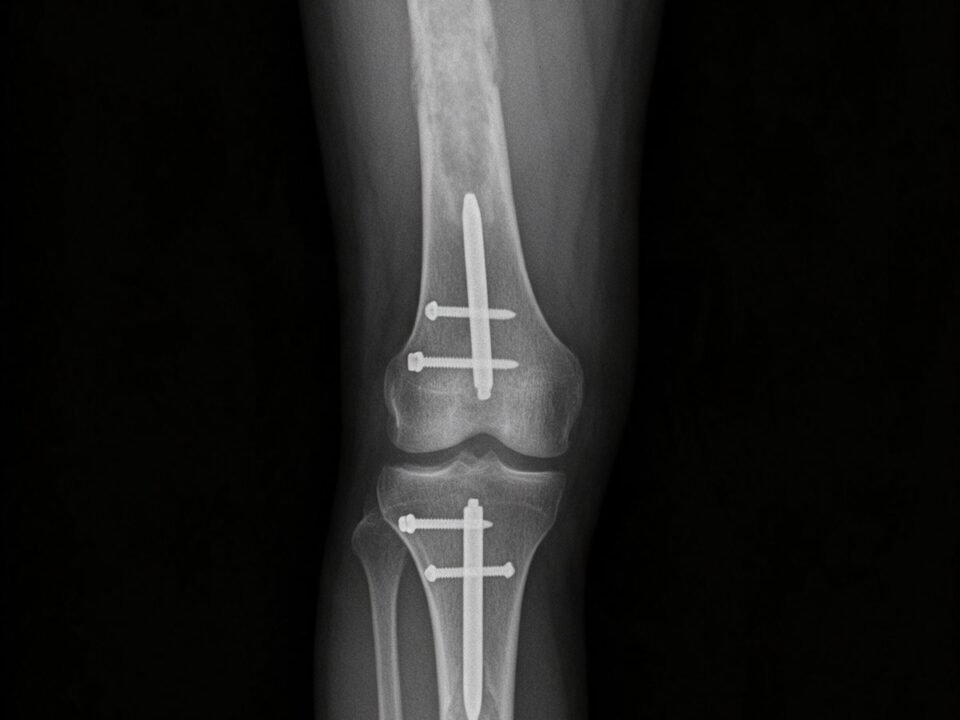
Femur or tibia? Choosing which bone to lengthen (and why proportions decide)
Most people ask which bone gives more centimetres. Surgeons ask which bone is relatively short on you. Gains, pain, speed, equinus, the peroneal nerve, and what a standing X-ray shows.
Read the article
Can You Have Limb Lengthening Twice? A Second Lengthening Explained
Whether you can have limb lengthening twice, how a staged femur-then-tibia plan differs from re-lengthening the same bone, how long to wait and what the research shows.
Read the article
How limb lengthening works: the biology of growing 8 cm of new bone
Where does the extra bone come from? A plain account of distraction osteogenesis: the cut, the week of waiting, the quarter-millimetre turns, and the months of hardening nobody films.
Read the articleBegin with a conversation.
No commitment, no pressure. Send your questions and, if you have them, your X-rays. You will hear back from a person within one working day.
Book a private consultation