Femur or tibia? Choosing which bone to lengthen (and why proportions decide)
Most people ask which bone gives more centimetres. Surgeons ask which bone is relatively short on you. Gains, pain, speed, equinus, the peroneal nerve, and what a standing X-ray shows.
Medically reviewed by Prof. Arshak Mirzoyan, MD, DMedSc. Last reviewed 29 October 2026.
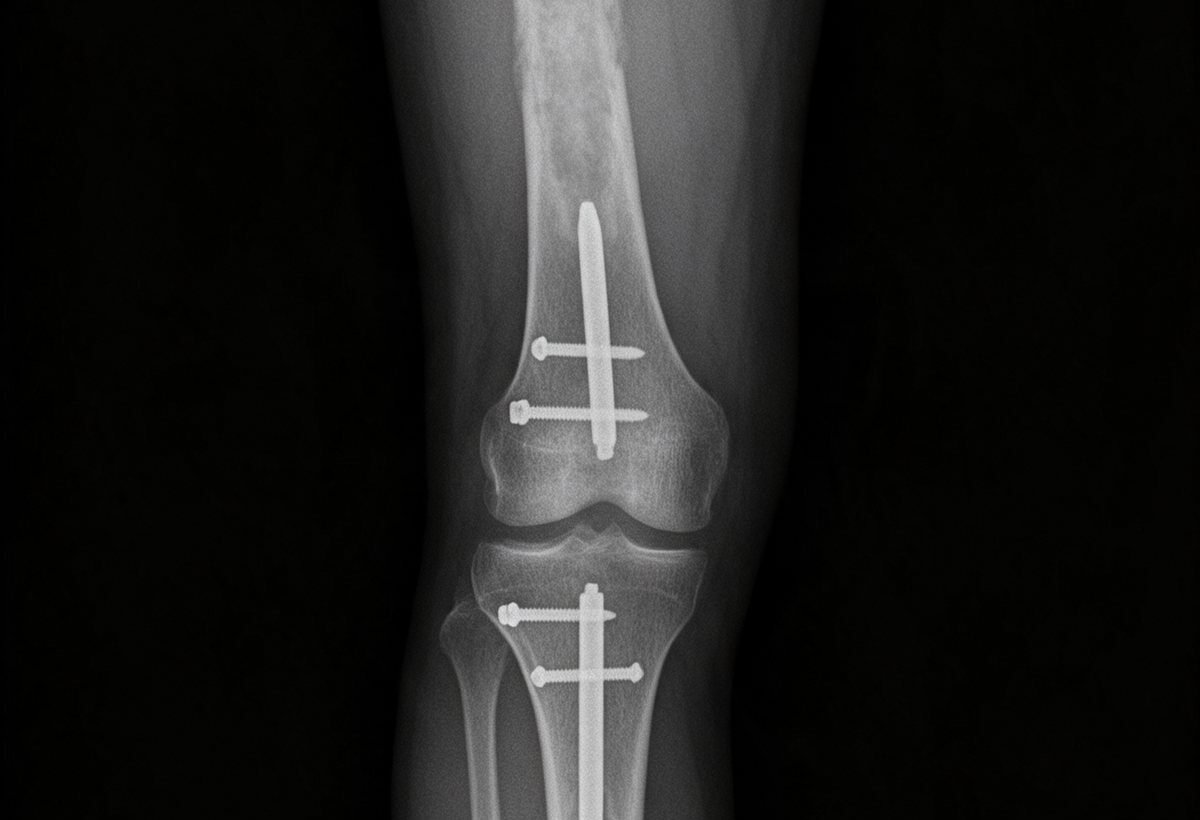
In short: The femur tolerates more lengthening (most patients 6 to 8 cm with LON) and is easier to live through; the tibia is slower, usually stops at 5 to 7 cm, and carries the equinus and peroneal nerve risks. Neither changes sitting height. Which bone is right is decided by tibia-to-femur proportions on a standing X-ray, not by which gives more.
A patient arrived in Yerevan last year having decided, over eight months of reading, that he wanted his tibias done. He had seen a forum thread saying femur patients end up “all thigh”, and he was not going to be all thigh.
Prof. Mirzoyan put his standing X-rays on the screen, measured both bones, and told him that his lower legs were already long for his thighs. Lengthening the tibias by 6 cm (about 2.4 inches) would have made him taller and would also have made him look, in the surgeon’s words, like a man standing on someone else’s shins. He had femurs done. He is happy. He is not all thigh.
The femur-or-tibia question is the first real decision in limb lengthening, and most people approach it backwards, asking which bone gives more centimetres. The right order is: which bone is relatively short on you, then which bone your soft tissue will tolerate, then how many centimetres. This article goes through all three.
Standing height is the only thing either bone changes
Start with what lengthening cannot do. The femur and tibia are both below the hip, so lengthening either adds to standing height and to nothing else. Your sitting height, the length from the chair to the top of your head, does not change by a millimetre. Your arm span does not change. Your shoe size does not change.
This matters because the eye reads proportion, not height. A person with a long torso and short legs who gains 7 cm (about 2.75 inches) in the legs ends up looking more conventionally proportioned, and the height gain reads as natural. A person who already has long legs for their torso and adds 7 cm more ends up looking leggier than before, and observant people notice something without being able to say what. The same 7 cm, two very different results, and the difference has nothing to do with surgical skill.
That is the first filter. The second is which of the two leg bones is carrying your height.
The femur: more room, more muscle, more knee
The femur is the biggest bone in the body, wrapped in the biggest muscles: quadriceps in front, hamstrings behind, the iliotibial band down the outside. That muscle mass is the reason the femur tolerates more lengthening. There is simply more soft tissue to share the stretch, more blood supply around the regenerate, and no single tendon as unforgiving as the Achilles.
In our experience most femur patients gain 6 to 8 cm with LON, and 8 cm is the ceiling we work to on a single femur. The nail goes in at the hip or the knee, so the incisions are there, and the pins of the external frame pass through the thigh muscles on the outer side.
Those pins are the femur’s particular burden. Every time the quadriceps contracts it moves slightly around a pin that does not move, which is why femur patients describe pin discomfort when they walk or do their physio, and why the thigh pin sites can be more irritable than shin pin sites. The other femur-specific problem is the knee. As the quadriceps and the iliotibial band tighten over the growing bone they pull the knee towards a bent position, and if that is not fought daily the result is a flexion contracture: a knee that will not fully straighten. Knee range of motion is the number the physiotherapist writes down every morning on a femur patient, and losing it is the most common way a femur lengthening disappoints.
Against that, femur patients walk earlier and more comfortably, the frame is on the thigh where loose shorts cover it, and the gait during distraction is closer to normal because the ankle and foot are untouched.
The tibia: less tissue, a tighter rope
The tibia is a thinner bone with less muscle around it, and the muscle it does have, the calf, ends in the strongest tendon in the body. When you lengthen the tibia you are lengthening the calf and the Achilles with it, and the Achilles does not like being lengthened.
The result is the tibia’s signature problem: equinus. As the calf tightens, the foot is pulled downward until it will not come back up to a right angle. A patient with equinus walks on the ball of the foot, cannot get the heel down, and if it sets in during distraction the surgeon may have to slow or stop lengthening, or release the Achilles surgically. Preventing it means stretching the calf and holding the ankle at ninety degrees, including at night with a splint or boot, for the whole of distraction. Patients who skip this do not get away with it.
The second tibia-specific risk is the peroneal nerve, which curls around the top of the fibula just below the knee, close to the skin and close to where pins and wires go. Irritation shows as tingling or numbness on the top of the foot or weakness lifting the toes; it is usually temporary, and it is one of the reasons surgeons are more cautious with the rate on the tibia. The tibia also comes with a passenger: the fibula, the thin bone alongside it, has to be cut too and fixed at the ankle so that it lengthens with the tibia rather than being left behind.
All of this is why tibia lengthening is slower, why surgeons usually stop at 5 to 7 cm rather than 8, and why we describe it as less forgiving. It is not worse. For a person whose shins are short relative to their thighs, it is the right surgery. It just asks more of the patient per centimetre.
Pain and speed, bone by bone
Patients ask which hurts more, and the honest answer is that they hurt differently.
Femur pain in the first days is deeper and more generalized, because more muscle has been disturbed and the bone is bigger. During distraction the femur’s discomfort is in the thigh and the front of the knee, worst at night and after physio, and the pin sites complain when the muscle moves. Tibia pain in the first days is often less, but during distraction the calf tightness is relentless, the ankle aches, and the shin pin sites, with little muscle to cushion them, are sensitive to touch and to knocks. Sleep is disturbed with either; with the tibia the night splint adds its own indignity.
On speed, the bone itself grows at the same rate in both, about 1 mm a day. But the tibia’s soft tissue is the limiting factor more often, so the surgeon more frequently slows the tibia’s rate to let the calf and the nerve keep up, and the consolidation phase is generally longer because the tibia has a thinner envelope of blood supply around the regenerate. The practical effect is that a 6 cm tibia often takes longer, start to finish, than a 7 cm femur. If you are choosing the tibia for proportional reasons, plan a longer road. If you are choosing it because you heard it was easier, you heard wrong.
The tibia-to-femur ratio, and why surgeons care more than you do
Here is the measurement that should drive your decision and almost never does, because you cannot see it in a mirror.
On a standing full-length X-ray, the surgeon measures the length of your femur from the hip joint to the knee joint, and the length of your tibia from the knee joint to the ankle, and compares them. In most adults the tibia is shorter than the femur by a fairly consistent proportion. People vary around that norm; some have relatively long shins and some relatively short ones, and the variation is normal and mostly invisible in everyday life. It stops being invisible when you lengthen one of the two bones by 7 cm.
Lengthen the bone that is already relatively long and you exaggerate whatever was unusual about your proportions. Lengthen the relatively short one and you move towards the norm, which is why the result reads as natural even to people who knew you before. This is why a surgeon who looks at your X-ray and says “tibia” when you wanted “femur” is not being difficult. He is looking at the number you cannot see.
It is also why “which bone gives more?” is the wrong first question. The femur gives more, nearly always. But the extra centimetre or two is not worth a result that looks assembled. The patients who regret lengthening, in our experience and in the published series, are disproportionately the ones who chased the number and were proportion-blind about how they got it.
What the surgeon looks for on your X-ray
When Prof. Mirzoyan reviews a prospective patient’s films, this is roughly what he is checking, in order.
First, that the growth plates are closed, which is why we do not operate under 18 and why a bone-age estimate matters for anyone young. Second, the two lengths and their ratio, as above, on both sides, because the two legs are not always equal and a small existing difference changes the plan. Third, the mechanical axis: a line from the hip to the ankle, and where it passes through the knee. A knee that is already slightly bowed or knock-kneed can be made worse by lengthening the wrong bone or improved by lengthening the right one with a small correction built in, and this is a decision only an experienced deformity surgeon should make. Fourth, the width and shape of the marrow canal, which decides whether a nail of the right diameter will fit, and the quality of the bone around it. Fifth, the joints themselves, the hip, knee and ankle, for early wear or old injury, because joints that are already unhappy will be loaded differently afterwards.
Only after all that comes the question of how many centimetres. Patients sometimes send us a single photo and a target height and ask for a quote. We can give an estimate, but the real answer is in the films, and we would rather tell you that now. Our surgeon’s background in deformity correction, not only cosmetic lengthening, is the reason this step is thorough.
Both bones, and in which order
If you need, or want, more than one bone can give, the answer is not to force one bone past its limit but to lengthen both, in stages. A staged femur-then-tibia plan can reach 12 to 16 cm in total, spread over two separate surgeries and recoveries, and it allows both bones to be lengthened in proportion so the result does not look like either bone was singled out.
The usual order is femur first, because it is the better-tolerated bone and the one that gives more, which lets the surgeon see how your tissue responds before committing to the harder segment. The gap between stages is months, long enough for the first regenerate to consolidate and for you to have lived with the new length. The price is per centimetre, the same as for a single segment ($4,000 per centimetre (12–16 cm: $48,000–64,000) with us, confirmed after X-ray review), but the total time out of ordinary life is roughly double, and the complication rate for doing both segments at the same time, rather than staged, is high enough that we do not offer it simultaneously. The staged femur and tibia page has the timeline; we have also written about what 5, 8, 12 and 16 cm scenarios actually look like.
The two bones side by side
| Femur | Tibia | |
|---|---|---|
| Typical gain with LON | 6 to 8 cm (about 2.4 to 3.1 inches); 8 cm is the ceiling per segment | 5 to 7 cm (about 2 to 2.75 inches) |
| Why it stops there | Knee flexion contracture; quadriceps and iliotibial band tightness | Calf and Achilles tightness (equinus); peroneal nerve |
| Pace | About 1 mm a day; rarely needs slowing | About 1 mm a day; more often slowed for soft tissue; longer consolidation |
| Pin sites pass through | Thigh muscle on the outer side; irritable with movement | Thin skin over the shin; sensitive to knocks |
| Incisions for the nail | Hip and/or knee | Knee (plus the fibula fixation at the ankle) |
| Extra bone involved | None | Fibula is cut and fixed as well |
| Night routine | Knee extension stretching | Ankle splint or boot to hold 90 degrees |
| Effect on proportions | Lengthens the thigh; right for relatively short femurs | Lengthens the shin; right for relatively short tibias |
| Sitting height | Unchanged | Unchanged |
| US published prices (for scale) | HSS $125,000; Premier Precice 2 bilateral $75,500 | HSS $135,000; Premier Precice 2 bilateral $85,500 |
| With Limblong (LON, single segment) | $4,000 per centimetre (8 cm: $32,000) all-inclusive on the medical side | $4,000 per centimetre (8 cm: $32,000) all-inclusive on the medical side |
Advertised prices from providers’ own pages and 2026 cost surveys, checked October 2026. A guide, not a quote.
One detail in that table is worth a sentence: US clinics price the tibia higher than the femur, by $10,000 at both HSS and Premier. That is a quiet admission, from people who do a lot of these, that the tibia is the more demanding segment. Our single-segment price is the same for either bone; the written quote follows the surgeon’s X-ray review either way.
Whichever bone you lean towards, read the full list of complications with that bone in mind. The list is the same; the odds shift.
Decide the bone before you decide anything else
Price, country, method, dates: none of it is worth planning until you know which bone, because the bone decides how many centimetres are available, how long you will be away, what your nights will look like and what the risks are. And you cannot decide the bone from a mirror or a forum. You decide it from a standing X-ray with a surgeon who measures both lengths and tells you which one is yours.
If you have films already, or can get a standing long-leg X-ray done locally, send them to Prof. Mirzoyan for a private consultation and ask him the one question that matters first: on my legs, which bone?
This article is educational and is not a substitute for a consultation with a qualified surgeon. Individual results vary.
Questions people ask
Is it better to lengthen the femur or the tibia?
For most people the femur: it tolerates more lengthening, typically 6 to 8 cm with LON, heals with fewer soft-tissue problems and is easier to walk on during distraction. But the right bone is the one that is relatively short on your standing X-ray. Lengthening an already long tibia can make proportions look odd, so surgeons measure before they recommend.
How much can you lengthen the tibia?
Usually 5 to 7 cm. The limit is set by the calf and Achilles tendon, which tighten and pull the foot downward (equinus), and by the peroneal nerve just below the knee. Pushing past that range sharply raises the risk of contracture, nerve irritation and a longer, slower consolidation. The surgeon sets the target from your X-rays and how your tissue responds.
Does limb lengthening change your sitting height?
No. Both the femur and the tibia are below the hip, so lengthening either adds only to standing height. Sitting height, arm span and shoe size stay the same. This is why proportions matter: adding leg length to someone who already has long legs for their torso can look unnatural, while adding it to someone with a long torso usually looks right.
Is tibia lengthening more painful than femur lengthening?
They hurt differently. The femur gives deeper pain in the first days and irritable thigh pin sites during distraction. The tibia often starts easier but brings relentless calf tightness, an aching ankle, sensitive shin pin sites and a night splint to prevent equinus. Overall most surgeons and patients describe the tibia as the more demanding segment per centimetre gained.
What is the tibia-to-femur ratio and why does it matter?
It is the length of your shin bone compared with your thigh bone, measured on a standing full-length X-ray. Most adults fall near a common proportion; lengthening the bone that is already relatively long exaggerates whatever was unusual, while lengthening the relatively short one moves you towards the norm and reads as natural. Surgeons use it to choose the bone.
Can you lengthen both the femur and tibia?
Yes, in stages, usually femur first and tibia months later once the first regenerate has consolidated. A staged plan can reach 12 to 16 cm in total while keeping the two bones in proportion. Doing both segments at the same time carries a much higher complication rate, which is why we do not offer simultaneous femur and tibia lengthening.
Keep reading
What is limb lengthening? A plain-English guide for people who have only just heard of it
Limb lengthening is surgery that cuts a bone and lets the body grow new bone into the gap, about a millimetre a day. Here is what that means in practice, who it is for and where it stops.
Read the article
The Ilizarov method, from a Siberian bicycle shop to today’s operating rooms
A country doctor, a nut turned the wrong way, a high jumper and an Italian explorer: how the ring frame from Kurgan became the basis of every lengthening method, and where it still belongs today.
Read the article
Limb Lengthening Surgery Day and Hospital Stay, Step by Step
What happens from admission to discharge for a LON limb lengthening: tests, anesthesia, the operation, the first steps and the four hospital nights.
Read the articleBegin with a conversation.
No commitment, no pressure. Send your questions and, if you have them, your X-rays. You will hear back from a person within one working day.
Book a private consultation