Limb Lengthening and Bow Legs: Can You Straighten and Lengthen at the Same Time?

In short: Often, yes. Bow legs (genu varum) can only be truly straightened by cutting the bone and changing its angle, an operation called an osteotomy, and limb lengthening also begins with an osteotomy. In suitable patients the surgeon can use the same bone cut to straighten the leg and then lengthen it, either by correcting the angle during surgery and lengthening on a nail, or by correcting gradually in an Ilizarov-type frame. Whether this makes sense for you depends on where the bend really is, which is measured on a standing full-length X-ray, and the correction adds planning and risks of its own.
Many people who ask about height surgery also dislike the shape of their legs: a gap between the knees when the ankles touch (bow legs) or knees that touch while the ankles stay apart (knock knees). This guide explains what surgeons actually measure, how straightening and lengthening can be combined, the trade-offs, and what to prepare before a consultation.
What “bow legs” means to a surgeon
Bow legs are called genu varum: the knees stay apart when the feet are together. Surgeons judge alignment by the mechanical axis, a line drawn from the centre of the hip to the centre of the ankle. In a straight leg this line passes close to the centre of the knee. In bow legs it passes towards the inner side of the knee, which loads the inner part of the joint more. It is measured on a standing X-ray that shows the whole leg from hip to ankle.
Not every visible gap between the knees comes from the bones. Calf shape, muscle and the way a person stands can make legs look curved even when the bones are fairly straight, and only the X-ray shows which situation you are in. That matters, because an osteotomy changes bone, not soft tissue.
The Hospital for Special Surgery in New York notes that progressive knee arthritis is common in adults whose bow legs were never treated, and that in adults the leg is straightened with an osteotomy. Operating purely to prevent future arthritis in someone without symptoms is more debated, so the decision usually rests on the size of the deformity, symptoms and your goals.
Why straightening and lengthening fit together
Both procedures need a controlled cut in the bone. If you are going to have a tibia lengthening anyway, the surgeon can plan the cut so that it also corrects the angle, instead of putting you through two separate operations and two recoveries. The correction is often made in the upper shin bone (tibia), where many bow-leg deformities sit. The thigh bone (femur) is chosen when the bend lies mainly there or, according to HSS, in larger deformities of more than about 12 degrees of varus. This is one reason why the choice between femur and tibia lengthening is not only about proportions.
Three ways it can be done
1. Correct the angle at surgery, then lengthen on a nail
The bone is cut, the angle is corrected immediately and fixed, and lengthening then proceeds along an intramedullary nail, either with an internal lengthening nail or with a frame used temporarily over a nail. A study in Acta Orthopaedica concluded that controlled acute correction of angular deformities combined with lengthening can be achieved with a motorised lengthening nail. The limitation is that the correction must be planned exactly in advance, because it cannot be adjusted afterwards.
2. Correct gradually in an external frame
With a circular Ilizarov frame or a hexapod frame, the angle can be corrected little by little while the bone is being lengthened. HSS describes circular frames as versatile and powerful tools for deformity correction, especially when the bone is bent in more than one plane or also rotated. The trade-off is living with an external frame for longer. Our article on the Ilizarov method explains how these frames work.
3. Straighten first, lengthen later
Sometimes the safest plan is staged: correct the alignment, let it heal, then lengthen in a later operation. This takes longer overall but keeps each step simpler.
A detail that matters: nail lengthening of the femur shifts the knee
A nail lengthens the femur along the anatomical axis of the bone, which is not the same as the mechanical axis. A study by Burghardt, Paley and colleagues in the Journal of Bone and Joint Surgery measured 27 femora lengthened on internal nails (mean 4.4 cm) and found that the mechanical axis moved outwards by about 1 mm for every centimetre of lengthening. In practice, femoral nail lengthening tends to push the leg slightly towards knock-knee alignment. For someone who is already knock-kneed this has to be planned for; for someone with mild bow legs it may help a little, but a good plan accounts for it rather than relying on it.
Knock knees (genu valgum) follow the same principles: the deformity is measured on the X-ray, and the correction is built into the osteotomy and the direction of lengthening.
Risks and honest trade-offs
- More complex planning. Combining correction and lengthening means more measurements and less room for error. Under- or over-correction is possible and may need adjustment.
- The usual lengthening risks still apply: joint stiffness, nerve irritation, infection around pins, slow bone healing and blood clots. See our overview of limb lengthening complications.
- Possibly longer treatment, especially with gradual correction in a frame or a staged plan.
- Appearance is not guaranteed. Straight bones do not change calf shape or how you stand, so the result may look different from what you imagine.
What to prepare before a consultation
- A standing full-length X-ray of both legs, from hip to ankle, if you already have one.
- Any history of knee pain, injuries or previous leg operations.
- A clear description of your goal: height, straighter legs, or both, and how much each matters to you.
Our surgeon trained under Prof. Ilizarov in Kurgan, and his practice includes correction of bow legs and knock knees as well as stature lengthening; you can read more on the surgeon page. At Limblong, limb lengthening is priced from $3,000 per centimetre, accommodation not included. Whether a correction changes your plan is decided individually after the X-rays are reviewed.
Questions to ask your surgeon
- Where exactly is my deformity, in the femur, the tibia or both, and how many degrees is it?
- Would you correct it at surgery or gradually, and why?
- How will lengthening itself change my alignment?
- What happens if the final alignment is not where we planned?
If you want both height and straighter legs, you can book a private consultation and send your X-rays for an assessment.
This article is general information. It does not replace a consultation with a doctor, and it is not individual medical advice.
Sources: Hospital for Special Surgery, How to Correct Bowlegs in Adults and Bowlegs (genu varum); Burghardt RD, Paley D, Specht SC, Herzenberg JE, The effect on mechanical axis deviation of femoral lengthening with an intramedullary telescopic nail, J Bone Joint Surg Br 2012; Acta Orthopaedica study on lengthening and deformity correction with motorised intramedullary nails.
Can bow legs be corrected during limb lengthening?
Often yes. Both need a bone cut (osteotomy), so in suitable patients the surgeon can correct the angle and lengthen the same bone, either by correcting at surgery and lengthening on a nail or by correcting gradually in an external frame. It depends on where the deformity is and how large it is.
Will limb lengthening make my bow legs worse?
It should not if alignment is planned. Lengthening the femur on a nail tends to shift the leg slightly towards knock-knee alignment, about 1 mm per centimetre in one study, so surgeons build this into the plan.
Can exercises or braces straighten bow legs in adults?
No. In adults the shape of the bone does not change with exercise or braces. Only an osteotomy changes the bone angle, although exercise can help strength and how the legs look in stance.
Does correcting bow legs add risk to limb lengthening?
It adds planning complexity and the possibility of under- or over-correction, and treatment may take longer. The usual lengthening risks, such as joint stiffness, nerve irritation and slow healing, still apply.
Keep reading

How limb lengthening works: the biology of growing 8 cm of new bone
Where does the extra bone come from? A plain account of distraction osteogenesis: the cut, the week of waiting, the quarter-millimetre turns, and the months of hardening nobody films.
Read the article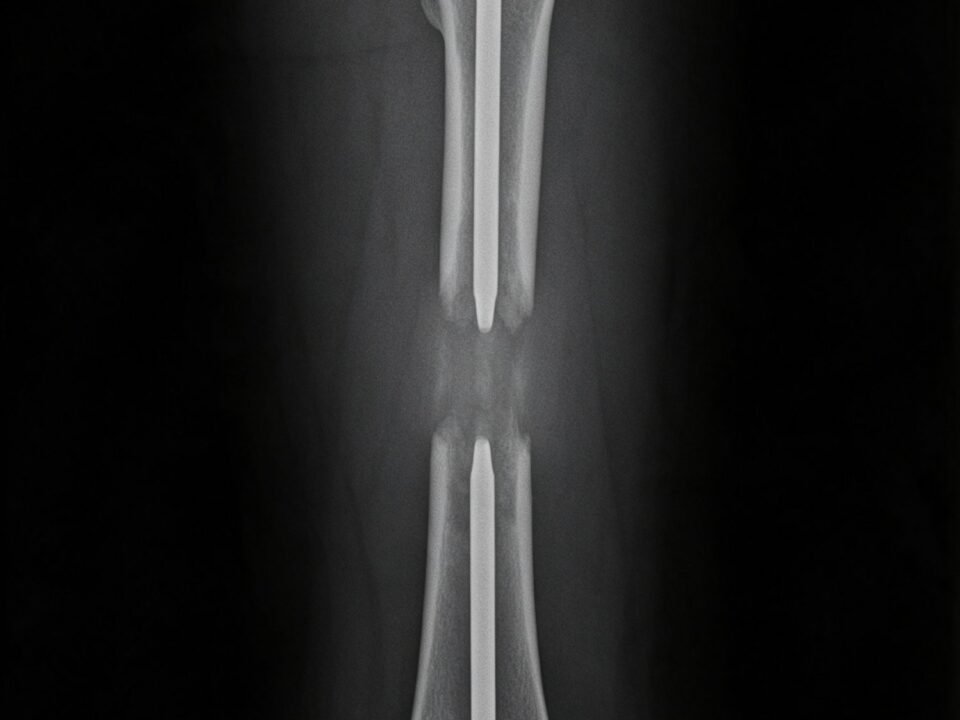
LON, Precice or Ilizarov: what each method feels like to live with
Three patients, the same 7 cm, three very different Tuesdays. How LON, a magnetic nail and the Ilizarov frame differ in sleep, showers, walking, scars, removal, failure modes and price.
Read the article
Limb Lengthening Surgery Day and Hospital Stay, Step by Step
What happens from admission to discharge for a LON limb lengthening: tests, anesthesia, the operation, the first steps and the four hospital nights.
Read the articleBegin with a conversation.
No commitment, no pressure. Send your questions and, if you have them, your X-rays. You will hear back from a person within one working day.
Book a private consultation