The Ilizarov method, from a Siberian bicycle shop to today’s operating rooms
A country doctor, a nut turned the wrong way, a high jumper and an Italian explorer: how the ring frame from Kurgan became the basis of every lengthening method, and where it still belongs today.
Medically reviewed by Prof. Arshak Mirzoyan, MD, DMedSc. Last reviewed 16 October 2026.

In short: The Ilizarov method is a ring external fixator and a biological principle: bone pulled apart slowly under stable tension grows new bone. Developed by Gavriil Ilizarov in Kurgan from 1951, proven on Valery Brumel in 1968 and adopted in Italy in the early 1980s, it underlies every lengthening technique used today, including LON and LATN.
The most consequential idea in modern orthopedics was worked out by a doctor nobody in Moscow had heard of, in a town most Russians could not place on a map, with a frame that looked like it had been built from a bicycle wheel. In a sense it had.
If you are researching limb lengthening you will see Ilizarov’s name everywhere: on the ring frames in old photographs, on the Kurgan institute that still treats thousands of patients, on the professional societies, and in the biography of our own surgeon, who spent the 1980s working under him. This article is about what the method actually is, where it came from, why it still matters when most cosmetic patients now choose a nail, and what its modern hybrid, LATN, looks like.
A country doctor and a nut turned the wrong way
Gavriil Abramovich Ilizarov qualified as a doctor in the last year of the Second World War and was posted, like many young Soviet graduates, to a rural district hospital, his in the Kurgan region east of the Urals, on the edge of western Siberia. The war was ending and the wards were full of men with fractures that had never healed, bones shortened by injury, and chronic bone infection. The standard treatments were long periods in plaster, bone grafts that often failed, and amputation.
Ilizarov’s response was mechanical before it was biological. He reasoned that a broken bone would heal if it were held absolutely still and, at the same time, the patient were allowed to walk on it. Plaster could not do both. So he built a frame: metal rings around the limb, connected by threaded rods, fixed to the bone by thin wires drilled straight through it and tensioned like the spokes of a wheel. The first version dates from 1951. The frames were made locally, in workshops with no orthopedic tradition, and the story that bicycle parts went into the early ones is repeated in Kurgan to this day. Whether or not every detail is true, the engineering logic is a bicycle wheel’s: a rim, spokes under tension, and remarkable rigidity from very little metal.
The discovery that turned a fracture frame into a lengthening method came, by his own account, from a mistake. A patient whose frame was meant to compress a non-healing fracture turned the nuts the wrong way and slowly pulled the bone ends apart instead. When Ilizarov X-rayed the leg, the widening gap was not empty. It was filling with new bone. He spent the following decades working out the rules under which that happened reliably: a low-energy cut that spared the blood supply, a week’s pause, then distraction at about 1 mm a day split into several small steps, all under a stable frame that let the patient keep walking. He called the principle the law of tension-stress. We have written about the biology in our article on how lengthening works; here, the point is that every rule a modern lengthening surgeon follows was written in Kurgan.
What a ring frame actually is
Picture two or more metal rings around the thigh or shin, each big enough to leave a gap between skin and metal. Through each ring, two or three thin wires pass clean through the bone and out the other side, fixed to the ring and tightened until they sing. Threaded rods connect the rings. Turning the nuts on those rods moves one ring relative to another by a fraction of a millimetre, and because the rings are fixed to the bone above and below the cut, the bone moves with them.
That is the whole device, and its genius is that the same hardware does several jobs. Turn all the rods equally and you lengthen. Turn one side more than the other, or add a hinge, and you correct an angle. Move a middle ring along the rods and you can transport a segment of bone across a gap left by infection or injury, which is how Ilizarov saved limbs that would otherwise have been amputated. Because the frame is rigid and the wires are tensioned, the patient can put weight through it, and Ilizarov insisted that they did: walking in the frame was part of the treatment, not a concession to it.
The price of that versatility is that the frame has to stay on for the whole process, distraction and consolidation both, because there is nothing inside the bone to protect the regenerate once the rings come off. For a lengthening of several centimetres that is many months in a frame that weighs on the leg, catches on everything, and has a dozen or more wire sites to keep clean. The frame’s modern descendants, hexapod frames with computer-planned struts, are more precise about correction but no lighter to live in.
Two patients who carried the method out of Siberia
For almost two decades the method was a provincial curiosity. Soviet orthopedics was centred on Moscow and Leningrad, Ilizarov had no academic post, and his claims sounded implausible. What changed that was not a paper but a patient.
Valery Brumel was the finest high jumper in the world in the early 1960s, an Olympic champion and world-record holder, until a motorcycle crash in the mid-1960s shattered his right lower leg. Over the following years he went through a long series of operations in Moscow that left him with an infected, shortened, non-healing tibia and a medical consensus that he would never compete again. In 1968 he went to Kurgan. Ilizarov put the leg in a frame, healed the fracture, restored the length, and Brumel went on to jump competitively again. A national hero walking out of Siberia on a leg the capital had given up on did what no journal could, and Kurgan became, slowly, a place the Soviet establishment had to take seriously. In time his clinic grew into a full research institute, with patients arriving from across the country.
The second patient opened the West. Carlo Mauri was an Italian mountaineer and explorer who had broken his leg in a skiing accident many years earlier and had lived since with a non-union and recurrent infection that no European surgeon had fixed. Around 1980 he travelled to Kurgan, spent months in a frame, and came home healed. His surgeons in Lecco, in northern Italy, wanted to know how, and in 1981 Ilizarov was invited to lecture in Italy, the first time the method had been presented to Western surgeons. The Italians adopted it with enthusiasm, trained in Kurgan, and founded ASAMI, the association for the study and application of the Ilizarov method, which still exists and of which our surgeon is a member. From Italy the method reached North America by the late 1980s, and the modern field of limb lengthening and reconstruction dates from that decade.
It is worth pausing on the timing. Prof. Mirzoyan arrived in Kurgan in 1980 and stayed until 1989. He was there for the Italian delegations, for the first Western visitors, and for the years in which the method went from Soviet secret to international standard. That is not a marketing line; it is a date range on a CV, and it is the reason we trust his judgment about frames.
What it is like to live in one today
We should be candid about this, because the history makes the frame sound romantic and living in one is not.
A classical Ilizarov lengthening means a ring frame on the limb for the entire course, commonly many months for a gain of several centimetres. Side-sleeping is out. Trousers do not fit over it. Each wire site needs daily care and, over that many months, some of them will become inflamed. The wires pass through muscle, and on the thigh that means every step moves muscle around a fixed wire. The frame can be adjusted, which is a real advantage when something drifts, but adjustments are done by the surgeon with a spanner, not by a magnet in your pocket.
Against that: you walk in it, often with full weight, from early on. There is no implant inside you afterwards, so there is no second operation to remove a nail. If your bone is also crooked, it can be straightened at the same time. And it is the cheapest form of lengthening wherever it is done routinely. For cosmetic patients with straight bones and a budget that can stretch to a nail, those advantages rarely outweigh the months in rings, which is why most now choose LON or a fully internal nail. We have compared what each is like day to day in a separate article, and the Ilizarov and LATN page describes how we use the frame.
Why surgeons still reach for the rings
If the frame is so hard to live with, why has it not been retired? Because there are problems only a frame can solve, and because the people who are good at lengthening are, almost without exception, people who learned on frames.
Infected bone cannot safely take an internal nail; a frame holds it from outside. A bone with a gap in it from trauma or tumour surgery can be transported across the gap with a frame and nothing else. A limb that is short and bent and rotated can be lengthened, straightened and de-rotated in a single frame, adjusted week by week as the X-rays dictate. Children with growth problems, adults with old fractures, patients in countries where a nail costs more than a year’s wages: all of these are frame patients, and they are the majority of the limb-reconstruction work done worldwide. Our surgeon’s 5,000-plus patients are mostly from this world, not the cosmetic one, which is exactly the experience you want behind a cosmetic case when something unexpected appears on a film.
There is also the simple point that every nail, magnetic or otherwise, is running Ilizarov’s biology. The nail did not change the rate, the latency, the corticotomy or the need for physiotherapy. It changed what is on the outside of the leg. A surgeon who understands the frame understands why the rules exist; a surgeon who only knows the nail knows the rules.
LATN: the frame’s modern compromise
Between the pure frame and LON sits a hybrid that keeps the frame’s strengths during distraction and borrows the nail’s strengths for consolidation. It is called LATN, lengthening and then nailing.
In LATN the lengthening is done with an external frame alone, exactly as Ilizarov did it. No nail is placed at the first operation. When the target length is reached, the patient has a second operation in which an intramedullary nail is inserted through the new bone and the frame is removed the same day. The nail then protects the regenerate while it consolidates, and the patient goes home with an ordinary-looking leg.
Why do it this way rather than LON, where the nail goes in from the start? Two reasons. First, during distraction there is no nail inside the bone, so there are no pins sitting next to an implant, and the theoretical route by which a pin-site infection reaches the nail is closed; a frame-only distraction is also fully adjustable, so an angle can be corrected mid-course. Second, some bones, particularly those that need deformity correction as well as length, cannot be lengthened straight over a nail. The price is a bigger second operation than LON’s frame removal, and a frame that is doing all the work during distraction, so weight-bearing in that phase is in the frame rather than shared with a nail.
Here is how the three relate.
| Classical Ilizarov | LATN | LON | |
|---|---|---|---|
| Nail inside the bone | Never | Inserted at the end of distraction | From the first operation |
| Time in a frame | Distraction and consolidation: many months | Distraction only: roughly the number of centimetres times ten days, plus latency | Distraction only, with a lighter frame |
| Weight-bearing during distraction | In the frame, often full | In the frame | Partial, shared between nail and frame, from the first week |
| Correcting an angle during distraction | Yes, by adjusting the frame | Yes | Limited; the nail holds the line it was given |
| Operations | Frame on; frame off | Frame on; nail in and frame off; optional nail removal later | Nail and frame on; frame off; optional nail removal later |
| Implant left afterwards | None | Nail, removable 1 to 2 years later | Nail, removable 1 to 2 years later |
| Typical use today | Reconstruction, infection, deformity, budget cases | Lengthening with deformity correction; patients wanting no pins near a nail | Cosmetic lengthening of straight bones; our primary method |
With us, LON is the primary method and is priced as an all-inclusive single-segment package at $4,000 per centimetre (8 cm: $32,000), with the written quote following the surgeon’s X-ray review; a classical frame or LATN course is planned and quoted individually, because the frame time depends on the deformity and the bone. The LON page explains why it is our default for straight-bone cosmetic cases.
The lineage behind the surgeon
We mention Kurgan a great deal, and it is fair to say why it matters rather than just repeat the name.
Prof. Arshak Mirzoyan trained and worked at Ilizarov’s institute from 1980 to 1989, wrote his doctoral thesis on the technique, and left with the habits the place instilled: respect for the blood supply at the corticotomy, patience with the rate, suspicion of anything that promises to shortcut consolidation. He later helped establish an Ilizarov centre at Aalborg Hospital in Denmark, worked as a visiting professor in Portland, Oregon, and in 1998 founded the Yerevan Center of Limb Lengthening and Reconstruction, which he still leads. The Kurgan institute has since made him an honorary professor. His full background is on the surgeon page.
Why does a cosmetic patient care? Because the moments that decide a lengthening are the ones where something is not going to plan: a regenerate that looks thin at week six, a knee losing degrees, an angle appearing on the film. A surgeon who spent a decade solving those problems with a spanner and a ring is the one you want reading your X-ray, whichever device is on your leg.
If you are weighing a frame
Most people who read this far will not choose a classical Ilizarov frame for cosmetic lengthening, and that is reasonable. But some should consider it or its LATN cousin: those on a tight budget, those who want nothing left in the bone, and anyone whose X-ray shows a bone that is short and crooked rather than just short. The frame is three-quarters of a century old because nothing has replaced what it does.
If you would like to know whether your case is a frame case, a LATN case or a straightforward LON, send your standing X-rays to a surgeon who learned the frame in the building where it was invented. You can book a private consultation with Prof. Mirzoyan and ask him what Ilizarov would have done with your leg.
This article is educational and is not a substitute for a consultation with a qualified surgeon. Individual results vary.
Questions people ask
What is the Ilizarov method?
A way of healing, lengthening and straightening bone using a circular external fixator: metal rings around the limb, connected by threaded rods and fixed to the bone with thin tensioned wires. Turning the rods moves the bone ends apart about 1 mm a day, and new bone forms in the gap. Developed by Gavriil Ilizarov in Kurgan from 1951, its biology underlies every modern lengthening technique.
Who was Gavriil Ilizarov?
A Soviet orthopedic surgeon who, posted to a rural hospital in the Kurgan region at the end of the Second World War, built a ring fixator to treat non-healing fractures and discovered that slowly separating bone ends made new bone grow. His 1968 treatment of high jumper Valery Brumel made the method famous in the USSR; Italian surgeons adopted it in the early 1980s and spread it worldwide.
Is the Ilizarov method still used for limb lengthening?
Yes, though most cosmetic patients now choose LON or a fully internal nail to avoid months in a frame. The classical frame remains the standard for lengthening combined with deformity correction, infected or non-healing bone, bone transport across gaps, and budget-limited cases. Its principles, the corticotomy, the latency week and the 1 mm a day rhythm, are used by every method.
How long do you stay in an Ilizarov frame?
For the whole treatment, distraction and consolidation, because there is no internal nail to protect the new bone once the rings come off. For a gain of several centimetres that is commonly many months. LATN, lengthening and then nailing, reduces frame time to the distraction phase by inserting a nail when the target length is reached and removing the frame the same day.
What is the difference between LATN and LON?
In LON the nail is placed at the first operation and shares the load with a light frame during distraction. In LATN distraction is done with a frame alone, and the nail is inserted in a second operation at the end, when the frame comes off. LATN allows angular correction during lengthening and keeps pins away from any implant; LON allows earlier partial weight-bearing and a smaller second procedure.
Can you walk in an Ilizarov frame?
Yes, and Ilizarov insisted on it. The tensioned wires and rings form a rigid external skeleton, so patients commonly bear full weight in the frame from early in treatment, which stimulates bone healing. The frame is heavy and awkward, and the wire sites need daily care, but walking in it is part of the method rather than an exception to it.
Keep reading

How many centimetres can you gain from limb lengthening? The honest ceiling
People arrive asking for 10 and leave with 7. Why one femur stops at 8 cm, how a staged plan reaches 12 to 16, where the risk curve bends, and what each number looks like in trousers.
Read the article
The LON method explained: lengthening over a nail, step by step, with the published numbers
LON combines an external frame, used only for the lengthening, with a nail inside the bone that protects it afterwards. Here is what each step involves, what the studies report and where the method struggles.
Read the article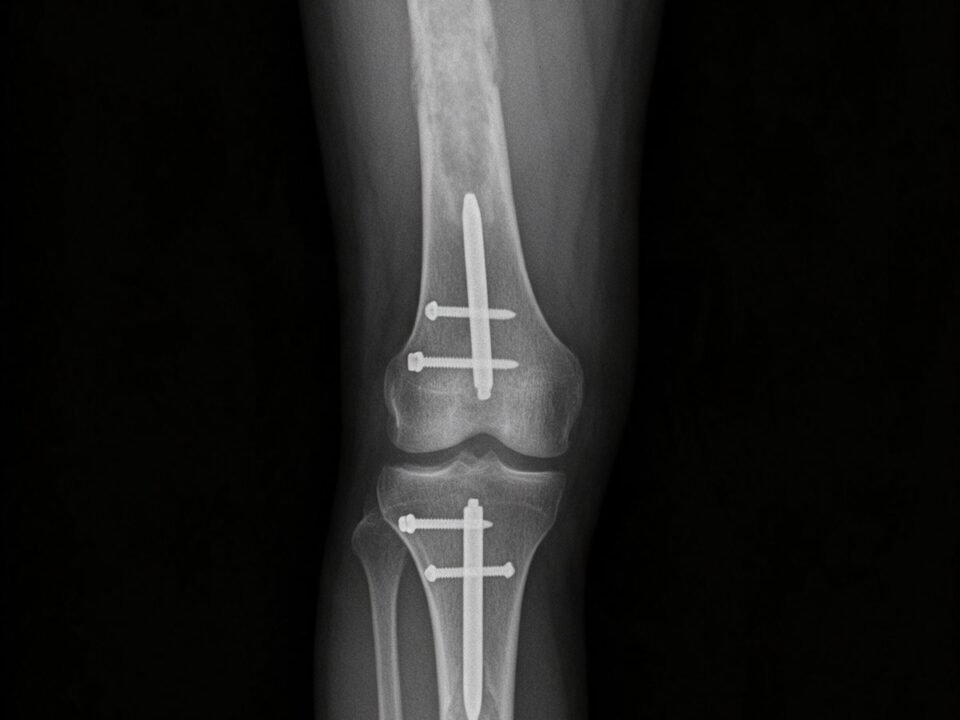
Femur or tibia? Choosing which bone to lengthen (and why proportions decide)
Most people ask which bone gives more centimetres. Surgeons ask which bone is relatively short on you. Gains, pain, speed, equinus, the peroneal nerve, and what a standing X-ray shows.
Read the articleBegin with a conversation.
No commitment, no pressure. Send your questions and, if you have them, your X-rays. You will hear back from a person within one working day.
Book a private consultation