What is limb lengthening? A plain-English guide for people who have only just heard of it
Limb lengthening is surgery that cuts a bone and lets the body grow new bone into the gap, about a millimetre a day. Here is what that means in practice, who it is for and where it stops.
Medically reviewed by Prof. Arshak Mirzoyan, MD, DMedSc. Last reviewed 20 October 2026.

In short: Limb lengthening is an operation in which a surgeon cuts a bone, waits about a week, then separates the two ends by roughly a millimetre a day so the body fills the gap with new bone. It was invented to correct legs of unequal length and is now also chosen for height. Expect months of treatment, a year before full recovery, and a real risk of complications.
If you have just typed “what is limb lengthening” into a search bar, you are probably in one of three positions. You saw a video of someone walking on a frame and could not believe it was real. Someone in your family has legs of different lengths. Or you are quietly wondering whether height can be changed after the growth plates close. The short answer is yes, and it is real, and it is also much more demanding than most videos suggest.
This guide explains the idea from the beginning, in plain language, and then points to the detailed articles when you want depth.
The idea in one paragraph
Bone is living tissue. When it breaks, it heals by building a soft scaffold in the gap and then hardening it. In the 1950s a Soviet surgeon named Gavriil Ilizarov discovered that if you pull the two ends of a healing bone apart slowly and steadily, the scaffold does not tear. It stretches and keeps forming new bone. Limb lengthening is that discovery turned into an operation: the bone is cut on purpose, held, and then lengthened at a rate the body can keep up with. The technical name is distraction osteogenesis, and we explain the biology step by step in how limb lengthening works.
What actually happens, in order
The sequence is the same whatever device is used.
First comes the operation. Under general anaesthesia the surgeon makes small incisions and cuts the bone, usually the femur (thigh bone) or the tibia (shin bone), without opening it up widely. A device is fitted to hold and later move the bone: an external frame, a metal nail inside the bone, or a combination of the two.
Then there is a wait of about five to seven days. Nothing is moved. The body is already laying down the first soft tissue in the gap.
Then comes lengthening, called distraction. Every day the two ends are drawn apart by roughly one millimetre, usually in several small steps. With an external frame you turn small screws. With a nail you make the movement with the leg itself or with an external magnetic controller, depending on the model. This is where most people walk with crutches or a walker.
When the target length is reached, the new bone, called the regenerate, keeps hardening. This consolidation phase is usually at least as long as the lengthening phase and often longer. The surgeon watches it on X-rays and clears you for full weight and, later, for sport.
Finally, depending on the device, a frame or a nail is removed in a second, smaller operation.

Where the new bone comes from
From you. There is no implant that becomes the extra length and no donor bone. The regenerate is your own bone, with its own outer shell and marrow canal, built by your cells in response to being gently stretched. That is why the procedure takes months and cannot be hurried: the biology sets the pace, not the surgeon.
Why people have it
Limb lengthening was developed for medical reasons and is still mostly done for them: a leg shortened by a childhood fracture, infection or growth disturbance; a congenital difference in length; bones that did not grow properly. In those cases the aim is to make the legs equal so that the pelvis, spine and gait work properly.
A smaller but growing group chooses it for height. A systematic review of cosmetic stature lengthening, published in Bone & Joint Research in 2020, pooled 795 patients from 11 studies. Their average age was about 26, and the average gain was 6.7 cm, with results ranging from 1.5 cm to 13 cm. Most patients were satisfied and had good function, and the authors counted major complications as relatively rare, while also calling for clearer guidelines, because the evidence is mostly case series. We read that paper closely, and we come back to it in how many centimetres you can really gain.
The three main methods
You will meet three names again and again.
The Ilizarov method uses an external ring frame fixed to the bone with wires or pins. It is the original, it is extremely adjustable, and it is the method that corrects angles and rotation as well as length. The cost is living with a frame for months. See the Ilizarov method.
Lengthening over nail (LON) combines a short period in an external frame with a steel nail inside the bone. The frame does the lengthening, and once the target is reached the nail locks the bone and the frame comes off, which shortens the time spent with hardware outside the leg. Our page on the LON method and the longer article on lengthening over nail explain it in full.
Magnetic or motorised nails, sold under names such as Precice, are placed entirely inside the bone and lengthened from outside with a controller. There is no frame and usually fewer pin-site problems, but the implant is expensive and not every bone suits it. We compare all three in LON, Precice or Ilizarov.
How long does it take?
For a gain of about 5 to 8 cm on one bone, lengthening itself takes around 50 to 80 days. Add the first week of waiting and the consolidation phase, and most people need to plan for three to four months of intensive treatment, then several more months of getting strength and movement back. Full bone remodelling continues for about a year. Our recovery timeline goes month by month.
What is it like?
Honest answer: harder than the videos. Pain is manageable but real, especially in the first weeks and at certain points of the lengthening. Muscles, tendons and nerves have to stretch with the bone, and they are the true limit on how much you can gain. Physiotherapy is not an extra, it is half of the treatment, and what you do daily with your knee and ankle decides your result. We wrote about this without euphemisms in how painful limb lengthening is and in the physiotherapy that decides your result.
What can go wrong
Every serious source agrees on the basics. The most common difficulty is stiffness of the joints next to the lengthened bone, especially an ankle that drifts downward (equinus) when the shin is lengthened. Pin-site infections happen with external devices. Less often there are nerve problems, delayed or failed bone healing, an angled bone, or a nail that breaks. The same systematic review found that problems and obstacles are common but are usually solved during treatment, while permanent complications are much rarer. That is not the same as “safe”. We set out the numbers in is limb lengthening safe and the failures in when limb lengthening goes wrong.
Who is not a good candidate
A good surgeon declines some people. Reasons include proportions that would look odd after lengthening, smoking that will not stop, uncontrolled medical conditions, unrealistic expectations, and distress about height that has become the centre of someone’s life, where the right first step is a psychologist rather than a surgeon. Our article on height dysphoria and screening explains why we insist on this.
What does it cost?
Prices vary enormously by country and by method. In Armenia the estimate is currently $4,000 per centimetre (8 cm: $32,000) (to be confirmed with the surgeon), while some US centres charge well over $100,000 for a magnetic-nail case. That range and what it includes is the subject of what limb lengthening really costs in 2026.
What to do next
If you are still at the “is this real” stage, read about the biology and the risks before anything else. If you are past that stage and want a surgeon’s view on your own legs, you can send your X-rays for a private consultation with Prof. Arshak Mirzoyan. He will tell you plainly whether you are a candidate, and sometimes that the answer is no.
This article is educational and is not a substitute for a consultation with a qualified surgeon. Individual results vary.
Questions people ask
What is limb lengthening in simple terms?
It is surgery that cuts a bone and then slowly pulls the two ends apart, about 1 mm a day, so the body fills the gap with new bone. It was developed to correct legs of different lengths and is now also used to gain height.
Is limb lengthening the same as leg lengthening?
Yes, in everyday use. Doctors say limb lengthening because arms and other bones can also be lengthened, while patients searching for height surgery usually say leg lengthening. In both cases the thigh bone, the shin bone or both are lengthened.
How much taller can you get from limb lengthening?
Most cosmetic patients gain 5 to 8 cm from one bone. In the largest systematic review the average was 6.7 cm. More than that usually means lengthening both femur and tibia in separate stages because soft tissue, not bone, is the limit.
How long does limb lengthening take?
Lengthening takes about 50 to 80 days for 5 to 8 cm, followed by months of bone hardening and rehabilitation. Most people plan for 3 to 4 months of intensive treatment and about a year before the bone is fully remodelled.
Is limb lengthening painful?
It is uncomfortable to painful in the first weeks and at certain stages of the lengthening, but pain is controlled with medication and usually settles. Many patients say the stiffness and the physiotherapy are harder than the pain itself.
Is limb lengthening safe?
It is a major orthopaedic operation with a real rate of problems, mostly joint stiffness, pin-site infection and slow bone healing. Most are solved during treatment, but serious complications do happen. Safety depends heavily on the surgeon’s experience and on choosing the right candidate.
Keep reading

Limb Lengthening Surgery Day and Hospital Stay, Step by Step
What happens from admission to discharge for a LON limb lengthening: tests, anesthesia, the operation, the first steps and the four hospital nights.
Read the article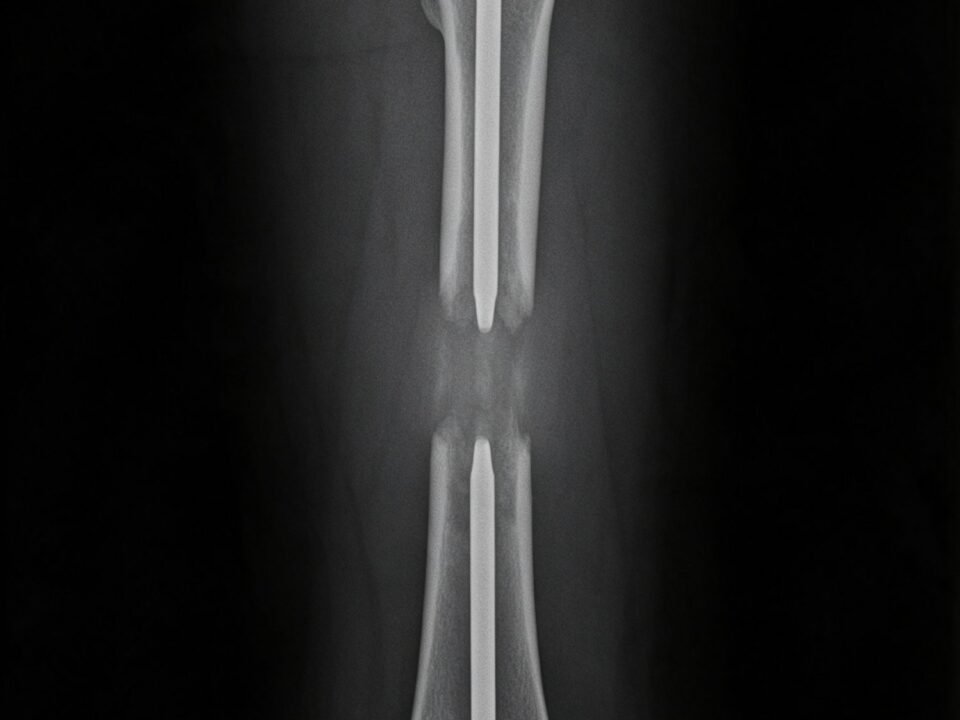
LON, Precice or Ilizarov: what each method feels like to live with
Three patients, the same 7 cm, three very different Tuesdays. How LON, a magnetic nail and the Ilizarov frame differ in sleep, showers, walking, scars, removal, failure modes and price.
Read the article
The Ilizarov method, from a Siberian bicycle shop to today’s operating rooms
A country doctor, a nut turned the wrong way, a high jumper and an Italian explorer: how the ring frame from Kurgan became the basis of every lengthening method, and where it still belongs today.
Read the articleBegin with a conversation.
No commitment, no pressure. Send your questions and, if you have them, your X-rays. You will hear back from a person within one working day.
Book a private consultation